
If your website is live but invisible on Google or buried so deep that no one ever finds it you’re not alone. One of the most common frustrations businesses face is realizing their website exists, yet it doesn’t rank, attract traffic, or generate leads.
The truth is simple: Google doesn’t rank websites by default. It ranks websites that meet specific technical, content, and authority requirements. If your site isn’t ranking, something in that system is broken.
Below are the real reasons your website is not ranking on Google, and what you can do to fix them.
Websites usually fail to rank on Google due to indexing issues, technical SEO problems, poor search intent matching, weak on-page optimization, low authority backlinks, or targeting keywords that are too competitive.
Before worrying about rankings, your website must be indexed. If Google hasn’t indexed your pages, rankings are impossible
If important pages don’t appear, you have an indexing issue.
Pages blocked by robots.txt
Incorrect noindex tags
Missing or broken XML sitemap
Poor internal linking
Fix:
Submit your sitemap in Google Search Console and ensure important pages are crawlable and internally linked.
Technical SEO is the foundation. If it’s weak, everything else struggles.
Slow-loading pages increase bounce rates and reduce rankings. Google prioritizes speed, stability, and mobile experience.
If your site isn’t mobile-friendly, Google will downgrade it especially for mobile searches.
Broken internal links, redirect chains, and server errors confuse search engines and waste crawl budget.
Fix:
Improve page speed, ensure responsive design, fix broken links, and clean up redirects.
This is where most websites fail silently.
You may be targeting the right keyword, but if your content doesn’t match what users expect, Google won’t rank it.
Trying to rank a sales page for an informational keyword or vice versa kills visibility.
Short, surface-level content cannot compete with detailed, helpful pages already ranking.
Fix:
Analyze the top-ranking pages and match their intent, depth, and structure then improve on them.
On-page SEO tells Google what your page is about.
Missing or poorly written titles reduce relevance and click-through rate.
Multiple H1s, missing headings, or poor hierarchy weakens clarity.
Pages without internal links look unimportant to Google.
Even with perfect content, authority matters.
Backlinks signal trust. Without them, rankings stall.
Low-quality or spammy links do more harm than good.
Fix:
Focus on earning relevant, high-quality backlinks and building topical authority over time.
Not all keywords are worth ranking for.
New or small sites struggle against established brands.
Long-tail, problem-based keywords convert better and rank faster.
Fix:
Prioritize intent and realism over search volume.
SEO is not instant but it’s not endless either.
1–3 months: indexing and early movement
3–6 months: ranking improvements
6+ months: consistent traffic growth
If nothing improves after six months, your strategy is flawed.
Basic on-page optimization
Content updates
Internal linking
Rankings are stuck long-term
Technical SEO issues exist
Traffic drops unexpectedly
If your website is not ranking on Google, the issue is rarely one thing. It’s a combination of technical problems, content gaps, authority issues, and poor keyword targeting.
SEO works best as a system, not a shortcut.
Still not ranking on Google?
If your website is indexed but stuck beyond page one, a professional SEO audit can reveal exactly what’s holding it back technical issues, content gaps, or authority problems.
Fill out this simple form to connect now!
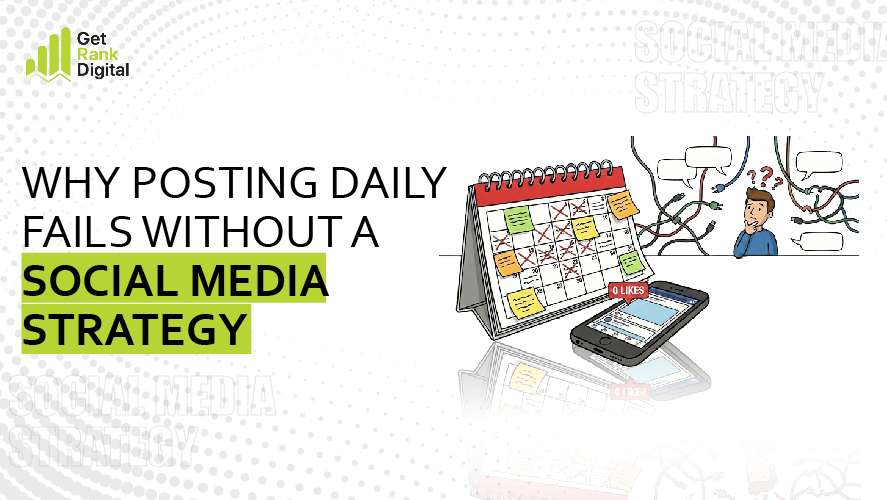
Posting daily on social media does not automatical...

In 2026, SEO isn’t broken most strategies are. I...
If your website is live but invisible on Google or...

In 2024, having a website for your business i...

If you’re a small business owner or someone look...

 +92 329 5221838
 info@getrankdigital.com
Date of Publish: 2026-01-21
(8) Comments